Steel Quality in Solar Energy Installation Systems: Which Steel Supports Your 25-Year Investment?
You're doing 25-year lifecycle calculations. You've prepared your ROI table, compared supplier offers. But there's one variable that most investors overlook during the bidding phase: the steel grade used for your assembly system. This "invisible decision" could have very tangible consequences 25 years later.
Steel Classification: What Does the S Code Mean?
In structural steel, the letter “S” stands for “Structural.” The number next to it indicates the yield strength of the steel in megapascals (MPa). This number represents the maximum load the steel can withstand without permanent deformation.
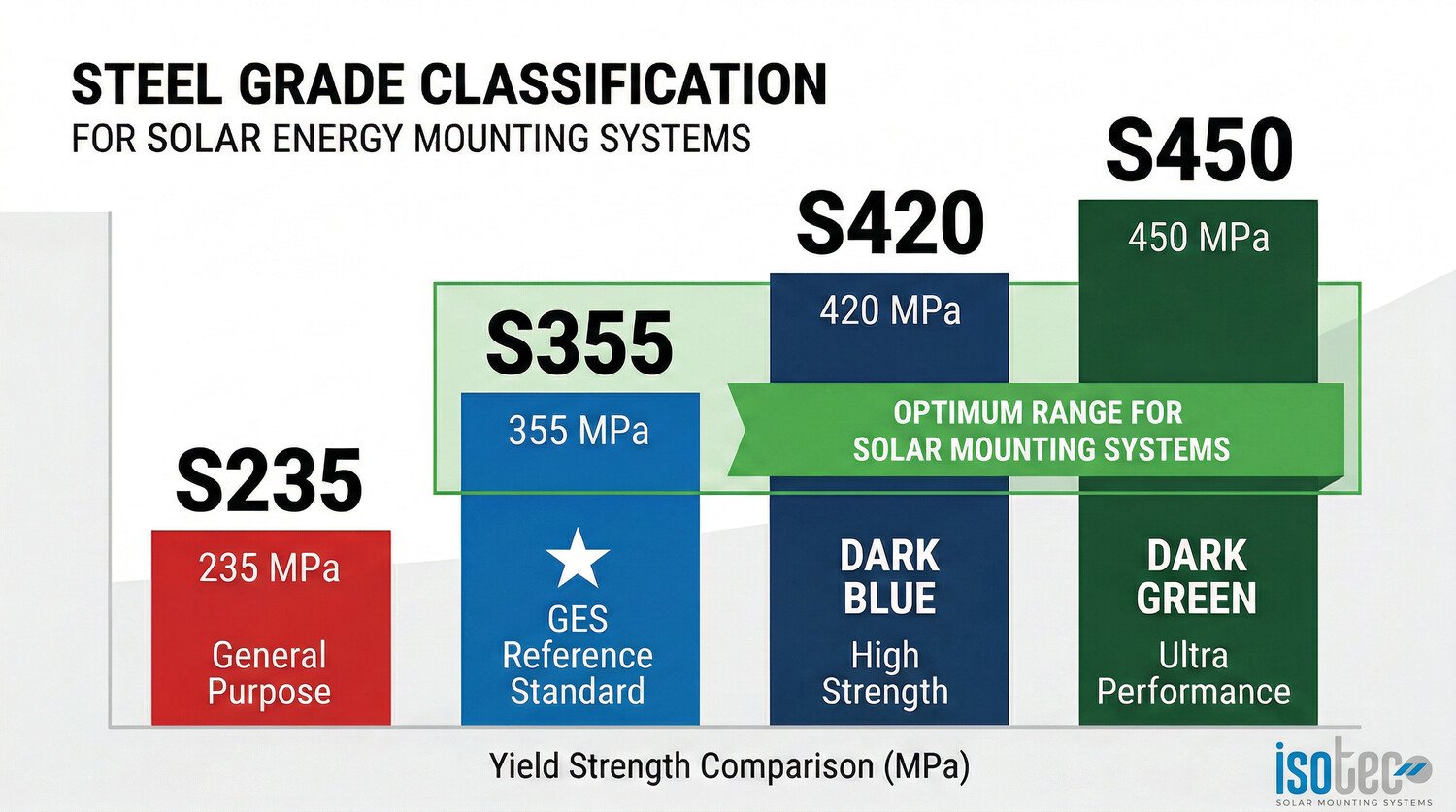
The classifications and application areas of solar energy mounting systems can be summarized as follows:
- S235 (235 MPa) — A common building material. Inexpensive and widely available; however, it has significant limitations in solar power projects.
- S355 (355 MPa) — The benchmark in the solar power sector. Balanced cost and performance.
- S420 (420 MPa) — High strength. Stronger structure with a thinner profile.
- S450 (450 MPa) — For long-span and heavily loaded systems. Preferred in large-scale land projects.
- S500–S690 — Ultra-high strength. For bridge and special industrial applications; it finds no practical use in solar power mounting systems.
The optimum range for solar power system mounting is considered to be S355–S450.
S235: Why is it common, why is it risky?
S235 is a classic structural steel that has been used in the construction industry for decades. It is inexpensive and readily available. However, it has several significant limitations in solar power projects.
Firstly, due to its low yield strength, using a thicker profile to carry the same load becomes necessary. This extra weight puts pressure on static calculations, especially in roofing projects.
Secondly, S235 has limited low-temperature toughness. In winter conditions, especially in cold climates, the risk of material fatigue cracking increases. This is a significant variable in a system operating under wind load for 25 years.
Third, corrosion protection: While traditional hot-dip galvanizing (HDG) is still common in the industry, it may not provide adequate protection in solar power plant projects with a 25-year lifespan expectation. The performance of HDG coatings is particularly limited by cut edges, scratches during assembly, and aggressive environmental conditions. Therefore, new generation coating technologies — zinc-aluminum-magnesium alloys such as Magnelis® (ZM) — are increasingly preferred.
S355 / S350GD: Reference Class for Solar Power Plants
S355 offers 51% higher yield strength compared to S235. In practical terms, this means you can carry 51% more load in the same profile cross-section. Or, conversely, you can carry the same load with a much thinner profile.
According to the EN 10025 standard, classes S355J2 and S355JR guarantee a toughness of 27 Joules at -20°C. This is certification that the structure maintains its integrity even in cold climates.
The S350GD is a variant suitable for cold forming, conforming to the EN 10346 standard. It is particularly preferred for roll forming applications in roof mounting systems.
S420 and S450: High Strength Classes
S420 offers approximately 18 percent higher yield strength than S355. This difference is tangible in profile savings: the cross-sectional area can be reduced by approximately 40 percent to carry the same load. Less steel means less weight, and lower transportation and assembly costs.
The S450 is used in large-scale land projects, long-span tracker systems, and structures requiring special construction. With 27% higher yield strength compared to the S355, it provides high performance in a slim profile.
Important technical note: S420 and S450 classes require stricter adherence to welding procedures (WPS - Welding Procedure Specification). Furthermore, certification according to EN 10025-3 or EN 10025-4 is required for both classes.
Let's Calculate: Is a Thicker Profile Always Stronger?
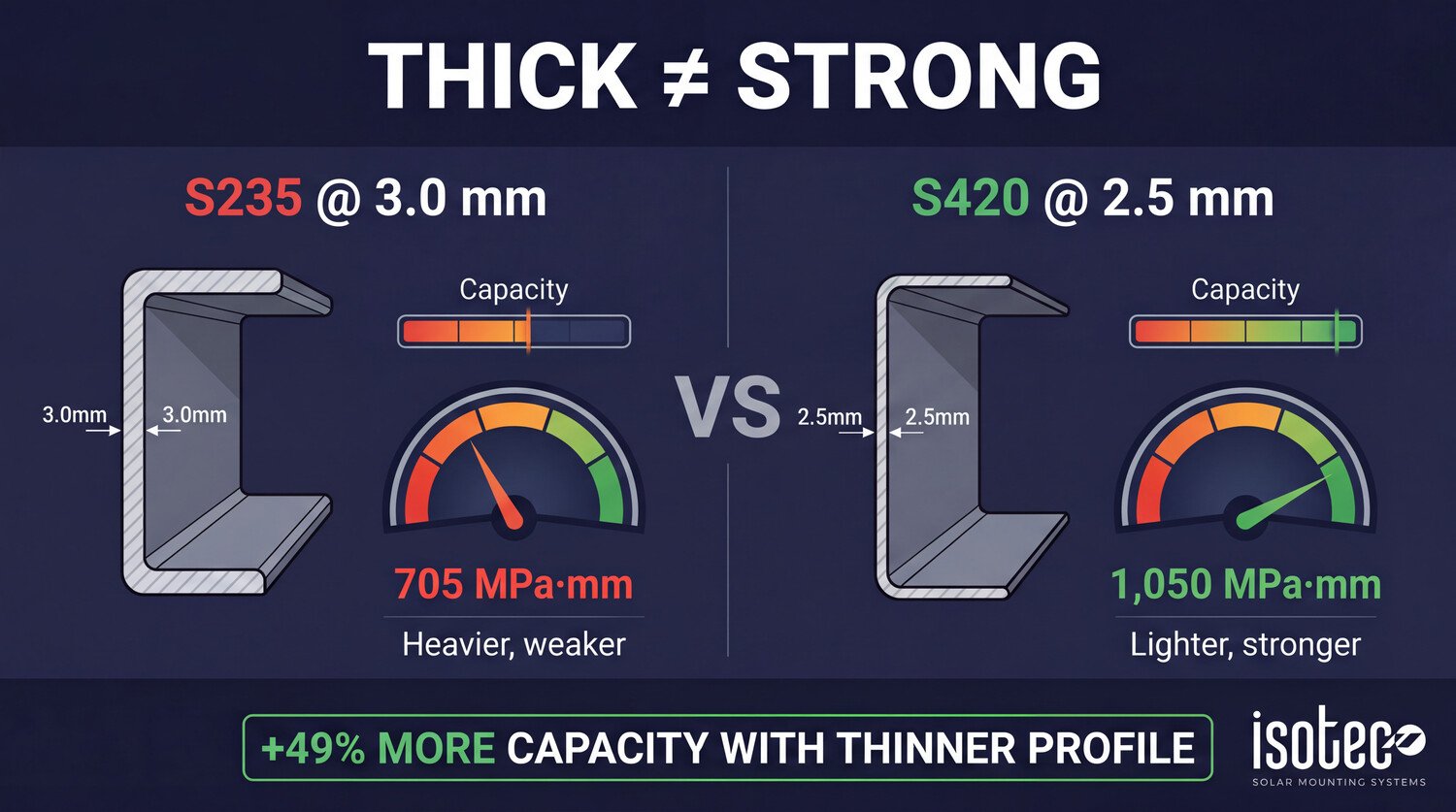
Some manufacturers emphasize the thickness by saying, "We used 3 mm profile." However, what is truly important is... material × thickness product, that is, it is a unit of capacity.
Yield Strength Comparison
| Steel Grade | Yield Strength | Difference Compared to S235 | Difference Compared to S355 |
|---|---|---|---|
| S235 | 235 MPa | — | − |
| S355 | 355 MPa | +%51 | — |
| S420 | 420 MPa | +%79 | +%18 |
| S450 | 450 MPa | +%91 | +%27 |
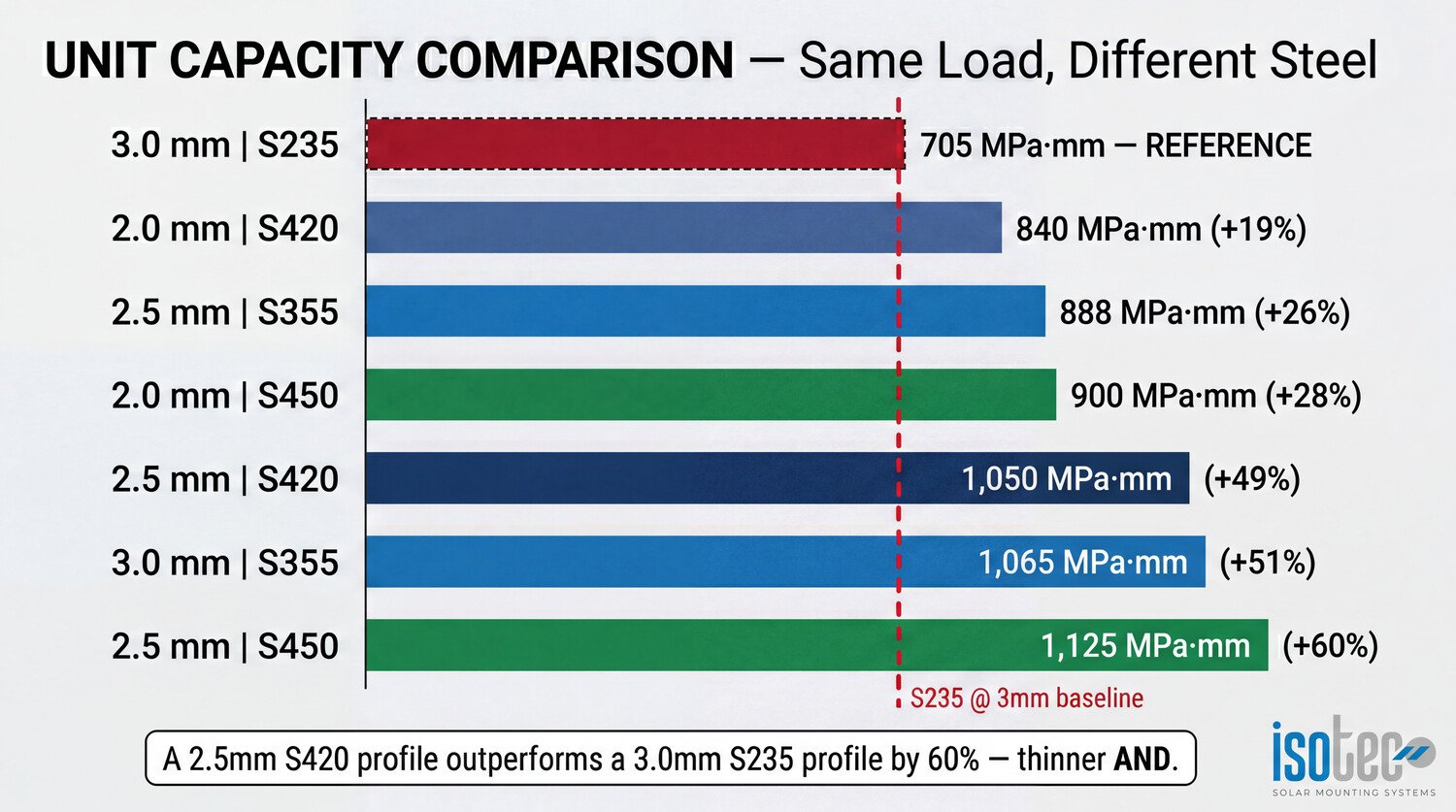
Practical Scenario — Different Profile Thickness, Different Steel Grade
| Profile | Steel | Unit Capacity (MPa·mm) | According to S235 @ 3 mm |
|---|---|---|---|
| 3.0 mm | S235 | 705 | Reference |
| 3.0 mm | S355 | 1.065 | + — same thickness, much stronger. |
| 2.5 mm | S355 | 888 | + — thinner, still stronger. |
| 2.5 mm | S420 | 1.050 | + — almost equivalent to the 3mm of the S235. |
| 2.5 mm | S450 | 1.125 | + — thinner than the competition, but much more durable. |
| 2.0 mm | S420 | 840 | + — a slim profile, yet superior. |
| 2.0 mm | S450 | 900 | + — weight advantage + high strength |
Conclusion: Seeing a 3mm profile on a system using S235 might be significantly less than seeing a 2.5mm profile on a system using S420 or S450. Judging by thickness alone without requesting documentation is misleading.
A Complete Comparison of Steel Grades
| Parameter | S235 | S355 | S420 | S450 |
|---|---|---|---|---|
| Yield strength | 235 MPa | 355 MPa | 420 MPa | 450 MPa |
| Tensile strength | 360–510 MPa | 470–630 MPa | 520–680 MPa | 550–720 MPa |
| Elongation | %26 | %22 | %19 | %17 |
| Low temperature toughness | Limited | 27J at −20°C | 27J at −20°C | 27J at −20°C |
| Profile advantage (compared to S235) | Reference | –35 savings | –45 savings | –50 savings |
| Coating compatibility (ZM/Magnelis®) | Standard | Standard | Compatible | Compatible |
| Welding processability | Easy | Good | WPS required | WPS required |
| Standard | EN 10025-2 | EN 10025-2 | EN 10025-3/4 | EN 10025-3/4 |
Theoretical Scenarios: What Does 25 Years Mean?
Scenario 1 — 500 kWp Rooftop System
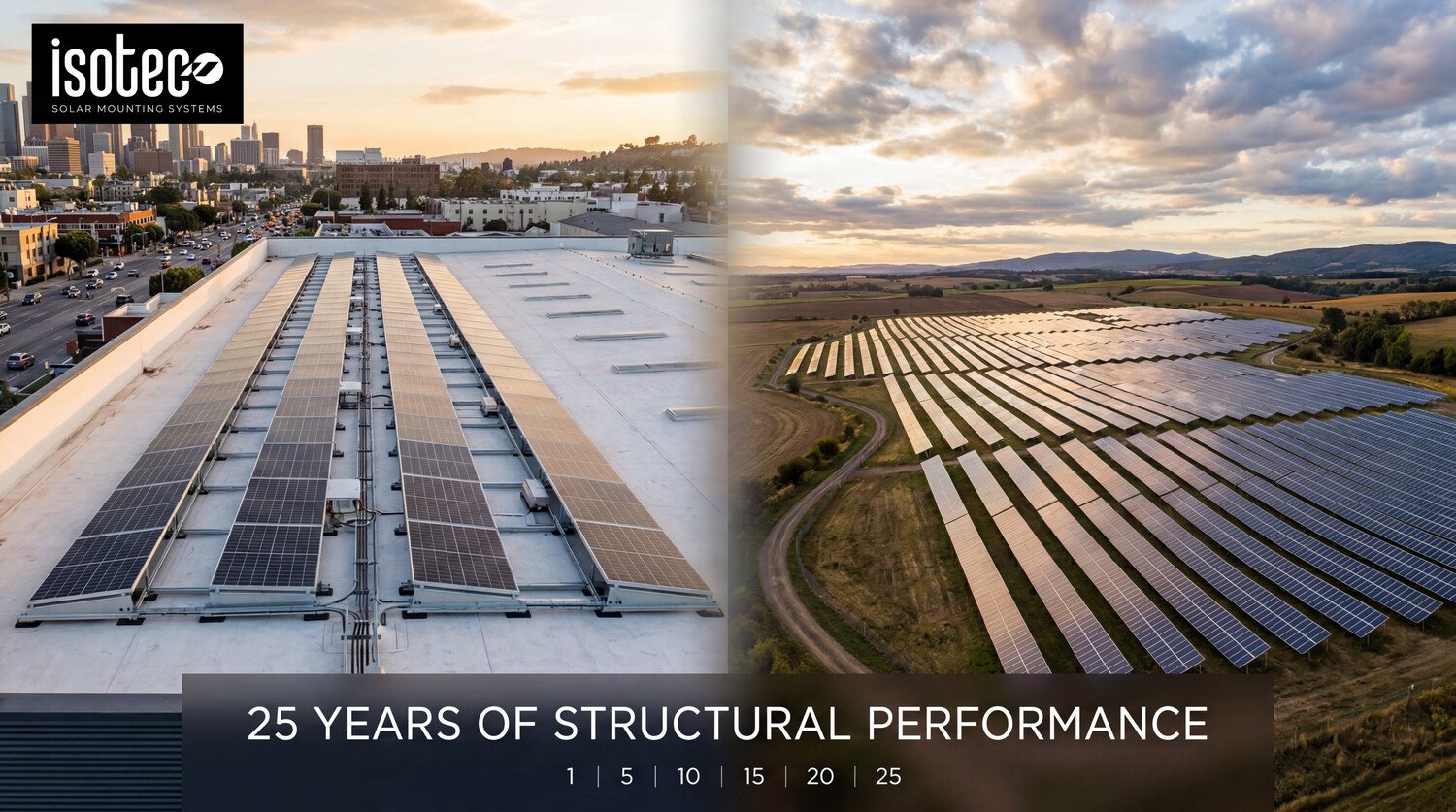
In a design using S235 steel, the low yield strength necessitates thickening the profile. This extra weight—typically between 1.2 and 1.8 tons—directly affects the roof's structural calculations. It's possible to achieve the same capacity with a much lighter system using a steel grade of S355 or higher. This difference in roof load capacity can be crucial for both structural safety and ease of installation.
Scenario 2 — 2 MWp Land Project
In large-scale land projects, mounting feet and purlins are subjected to cyclic wind loads for decades. Due to the limited toughness of the S235, long-term risks related to material fatigue can arise in high cyclic loading environments. The S420 or S450 class eliminates this toughness problem; at the same time, the use of a lighter and thinner profile reduces logistics and assembly costs.
Scenario 3 — 20th Anniversary Review
Studies show that systems constructed with S235 and using traditional HDG cladding may require maintenance or partial renovation at critical points between 15 and 20 years. This cost typically represents between 3 and 5 percent of the total project value. However, with S355 and higher classes, and systems implemented with next-generation cladding technologies like Magnelis®, the only operation required in the twentieth year is visual inspection and cladding thickness measurement.
Why is the S235 being used?
There are several reasons why some manufacturers use S235. The most basic reason is price: S235 is 8 to 12 percent cheaper per ton than S355. In large projects, this difference can be used as a tool to lower the bid price.
The second reason is vague specifications. When general terms like "structural steel" or "S-series steel" are used in technical specifications, the manufacturer can leave the class selection to their own discretion. If the standard and class are not clearly specified in the specification, it becomes difficult to understand which steel is being used in the offer.
Therefore, asking the right questions during the bidding phase is critical for solar power plant investors.
6-Item Checklist
When evaluating offers, check the following six points:
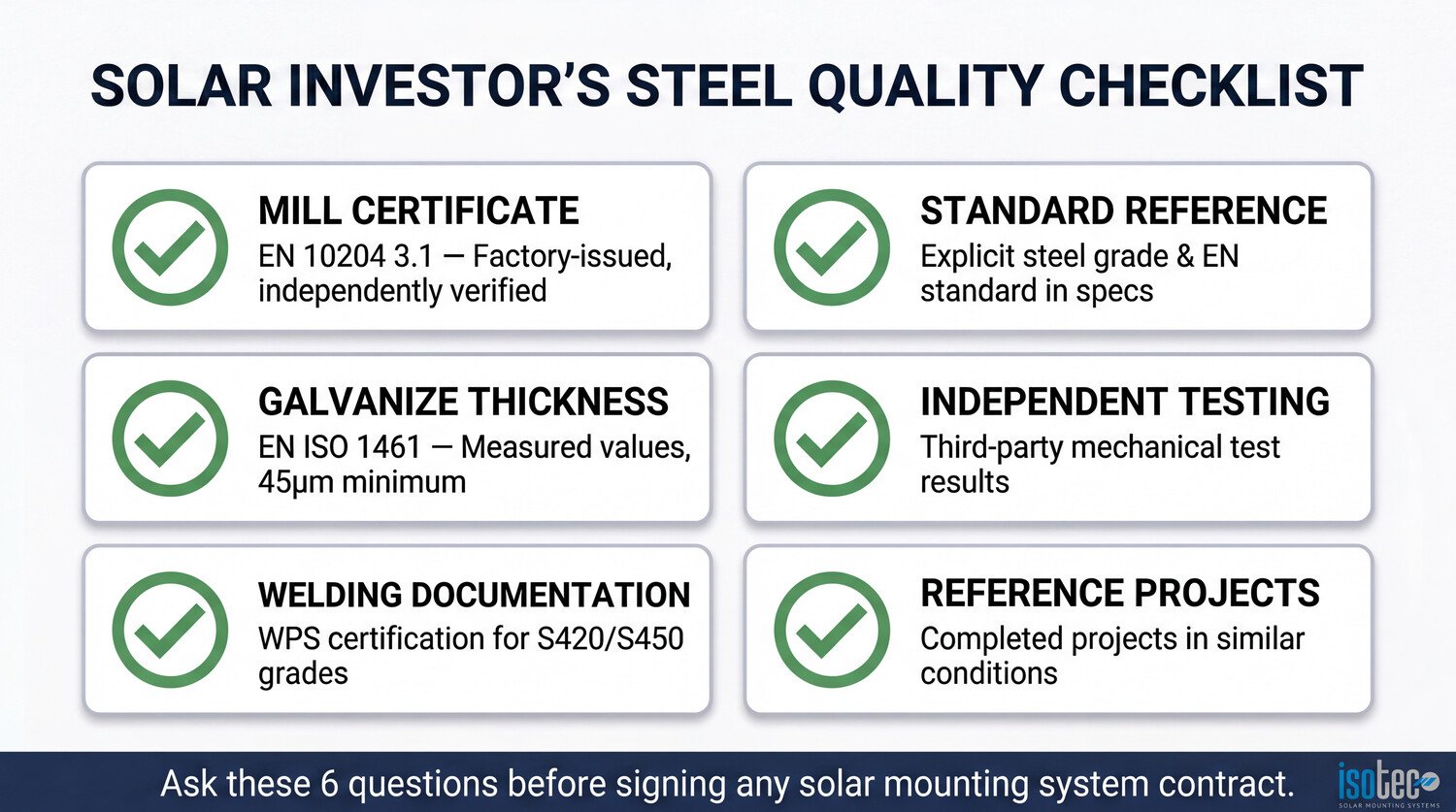
- Mill Certificate (EN 10204 3.1): Request a certificate from the manufacturer's factory for each batch, containing independent approval. EN 10204 2.1 or 2.2 is not sufficient.
- Standard Reference: The specification must clearly refer to the steel grade and EN standard used. Does it say "S355," or simply "structural steel"?
- Coating Technology and Thickness: Which corrosion protection method is being used? Traditional hot-dip galvanizing (HDG) or a new generation zinc-aluminum-magnesium coating like Magnelis® (ZM)? ZM coating offers up to 3 times longer corrosion life than HDG. Is the coating thickness a measured value or a nominal value?
- Independent Testing: Can the manufacturer provide third-party mechanical test results in addition to their own certification?
- Source Document: Is a WPS (Welding Procedure Specification) available for S420 and S450? Are welder certifications available?
- Reference Project: Can you provide references to completed projects of similar size and climatic conditions?
ISOTEC Solar Approach
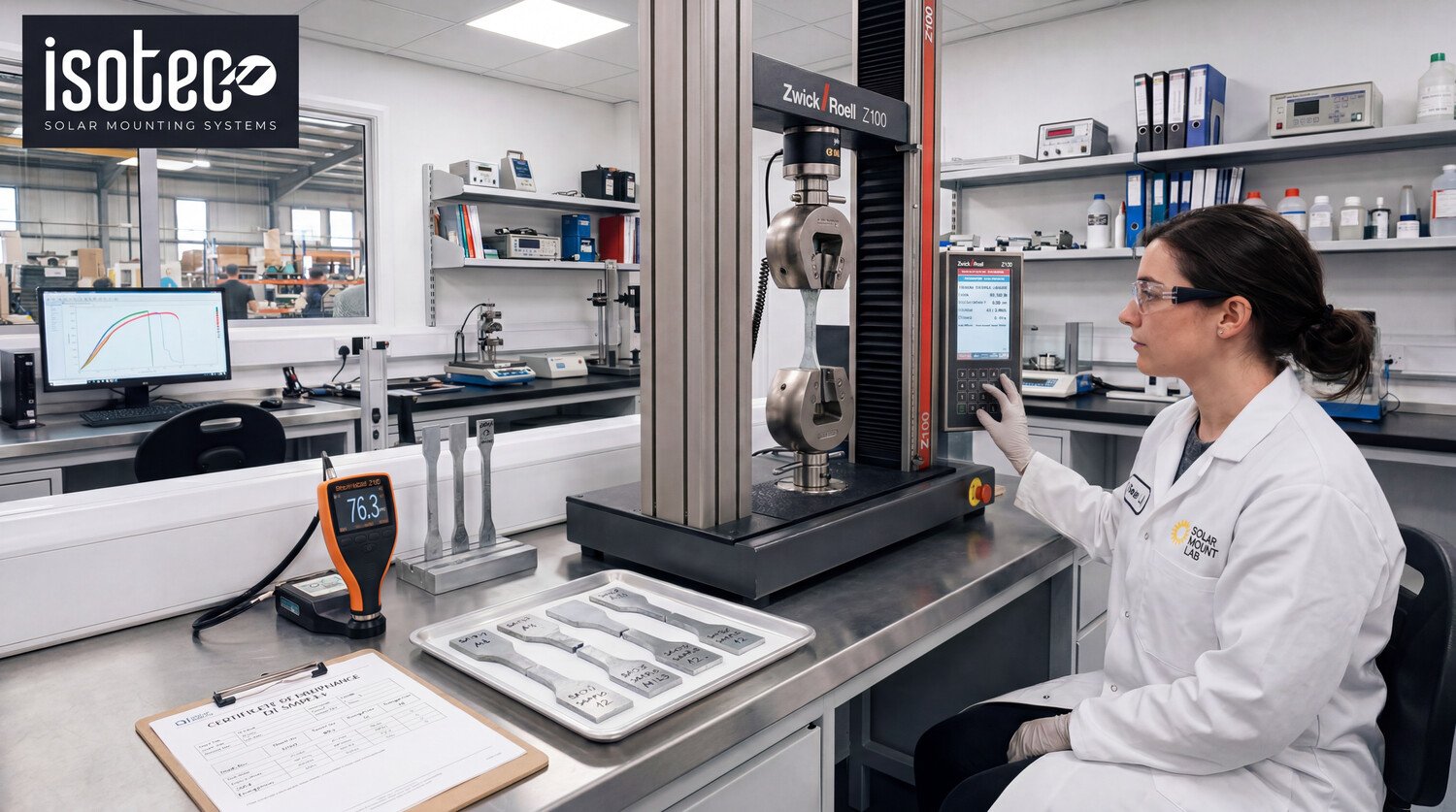
At ISOTEC Solar, we consider steel grade selection a fundamental design parameter in our design and manufacturing processes. We work with grades between S355 and S450; the appropriate grade is determined according to project requirements, ground conditions, and load calculations.
Instead of traditional hot-dip galvanizing in corrosion protection Magnelis® (ZM) coating technology We prefer it. Developed by ArcelorMittal, this zinc-aluminum-magnesium alloy coating offers up to 3 times longer corrosion resistance than traditional galvanizing. Its self-healing properties at the cut edges also provide active protection against damage that may occur during assembly. You can read our detailed technical article about Magnelis® technology here.
EN 10204 3.1 mill certification is part of our standard practice for all our products. Coating thickness measurements are performed on-site to assess coating performance. The manufacturer's certificate can be independently verified prior to application.
This approach is shaped by the goal of preserving the original design capacity of the structure throughout the 25-year duration of the investment.
Invisible Decision, Visible Result
Steel grade selection appears to be an invisible variable in the return on investment calculations for solar energy. However, this "invisible decision" has quite tangible consequences 15 or 20 years later: it has a direct impact on maintenance costs, structural integrity, and insurance processes.
At ISOTEC Solar Mounting Systems, we recommend that solar power plant investors evaluate this variable from the very beginning of the proposal. For questions regarding the steel quality and certification processes of your project, please contact us. You can contact us.