
1 MW Solar Power Plant: Engineering or Tonnage?
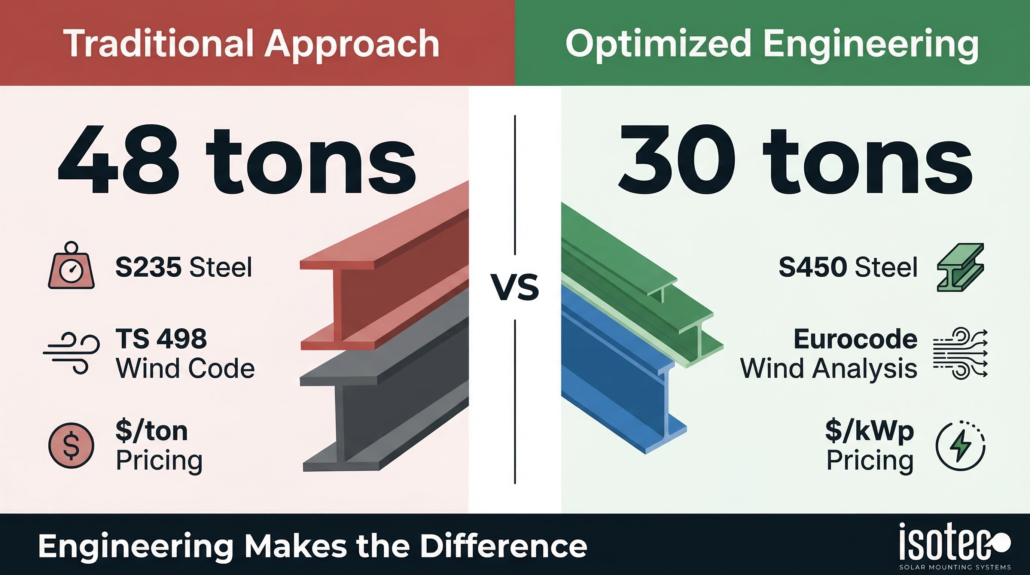
Same Power Plant, Two Different Offers
Imagine you receive two quotes for a 1 MW solar power plant. One proposes a 30-ton steel mounting system, the other a 48-ton system. Both are priced similarly. Which one would you choose?
Most investors think, "48 tons should be stronger." But in engineering, more material doesn't always mean better. In fact, sometimes it shows the opposite: inadequate engineering.
This article explains, using technical data, where tonnage discrepancies in solar energy installation systems come from, the critical errors in calculation methods, and how pricing models mislead investors.
S450 vs S235: Aynı Dayanım, %37 Daha Az Çelik
The quality of steel used in solar energy installation systems directly determines the overall weight of the structure. Here's a comparison:
| Parameter | Design with S235 | Design with S450 |
|---|---|---|
| Yield Strength | 235 MPa | 450 MPa |
| Total Steel Per 1 MW | ~48 tons | ~30 tons |
| Shipping Cost | High | %37 daha düşük |
| Base Load | Heavy | Lightweight — reduces basic costs. |
| Assembly Time | Longer | Shorter — labor costs decrease. |
In the early years of the sector, for 1 MW 60–70 tons of steel while used in the past, today with proper engineering 30 tons/MW It's possible. If you're still receiving offers for 48 tons, the question is: Is this additional 18 tons a structural requirement, or a product of the calculation methodology?
The Unseen Danger in SAP2000: Lateral Sprains
One of the most critical control points in steel structure design. lateral sprainThis is lateral torsional buckling (LTB). Especially in solar energy mounting systems, purlin profiles are subjected to pressure at their upper flanges under wind suction loads and are prone to buckling in the lateral direction.
Where does the problem begin?
In structural analysis programs such as SAP2000, the program node points have lateral support by default. It accepts this. When the element is divided into intermediate node points, it treats each sub-segment as a separate support length. This misleads many engineers because:
- Solar panels for lovers It does not provide sufficient lateral support.. The panel connection only partially restricts one header; the opposing header remains open to buckling.
- In the case of wind uplift, the pressure head is released — the structure is freed from the design wind. at much lower loads It can migrate.
- Even if the program says "stress is sufficient," this result is unacceptable if LTB (Low Voltage Testing) is not checked. It is not reliable.. The user needs to manually define the unbraced lengths according to the actual situation.
So how is it done correctly?
To shorten the lateral buckling length, between the profiles. right rod (cross link) is added. The cost of a right rod increases by one cross-sectional size of the profile. It is much more economical. —because a 12-16 mm diameter steel bar is many times cheaper than increasing the profile along the entire purlin. Proper engineering doesn't increase the profile — it adds lateral support.
Instead of conservatively using a Cb (moment modification) factor of 1.0, calculating it according to the actual moment distribution is also part of section optimization. According to AISC 360, Cb=1.0 is the worst-case assumption (constant moment); in actual load distributions, the Cb value varies between 1.14 and 2.27. With the correct Cb value, the same profile can be achieved at the same safety level. longer spans It can pass.
Wind Load Calculation: TS 498 or Eurocode?
Wind load is the most crucial parameter in solar energy installation system design. However, the standard used for its calculation fundamentally changes the outcome.
| Parameter | TS 498 (Old Turkish Standard) | TS EN 1991-1-4 (Eurocode) |
|---|---|---|
| Turbulence Effect | Not calculated | Detailed model with turbulence intensity Iv(z). |
| Topography Factor | Annoyed | Hills, slopes, and coastlines are modeled separately. |
| Edge/Corner Region Separation | Simplified | Regional external pressure coefficients (cpe) — the edge area is up to twice as high as the center. |
| Dynamic Effect | It is neglected | Structural factor cscd modeled with |
| Conclusion | Significantly lower wind load | Realistic and safe. |
Wind load calculated according to TS 498 is based on Eurocode. konfigürasyona bağlı olarak %20 ile %40 arasında It could be lower. In TS 498, velocity pressure is simply calculated using the formula q = v²/1600 — there is no distinction between turbulence intensity, the first mode frequency of the structure, and the regional pressure coefficient. What does this mean? Choosing a thinner profile means a lighter structure and a "cheaper" offer on paper. But in real wind, this structure will start to stress much earlier than it was designed.
Low wind load = thin profile = cheap price. But this is also the first power plant to go down in a storm.
Eurocode is mandatory in Europe. However, in Türkiye, projects are still being produced that "pass" using TS 498. Investors only realize the difference when the first serious storm hits.
Pricing Model: Selling Steel Like a Sack of Flour
There is a fundamental difference in approach between Türkiye and Europe regarding the pricing of solar power system installations:
European standard: $/kWp (or cents/Wp)
- The price automatically scales up when the panel power increases from 550W to 700W.
- The investor directly links the cost of the installation system to the power plant capacity.
- Offers for different panel power levels can be compared.
Turkish usage: 1 TP4T/ton
- The comparison becomes meaningless when the panel power changes.
- The tonnage calculated with a 550W panel is not the same as with a 700W panel.
- Heavy construction looks less like it's "expensive" and more like it's "purchased a larger quantity."
Pricing is based on tonnage., rewards heavy construction. More steel = more sales. By reducing weight through clever engineering, the company ends up selling less in the $/ton model.
Pricing is based on kWp. rewards engineering quality. A company that can achieve the same capacity with less material offers a more competitive bid to the investor.
The question is simple: Are you buying an assembly system or steel?
Conclusion: Engineering Makes a Difference
Choosing a solar energy mounting system is not a decision to buy steel. It is an engineering decision..
- The difference between 30 tons and 48 tons stems from the quality of the materials and the calculation method.
- A structure that "passes" SAP2000 without lateral buckling control may be unsafe in the field.
- Wind loads calculated using TS 498 may not reflect actual conditions.
- Pricing based on tonnage rewards heavy construction — pricing based on kWp rewards smart engineering.
Our only question to the investor is: Are you buying engineering services or tonnage?