Solar Power System Installation Systems in Earthquake Zones: A Safe Design and Implementation Guide
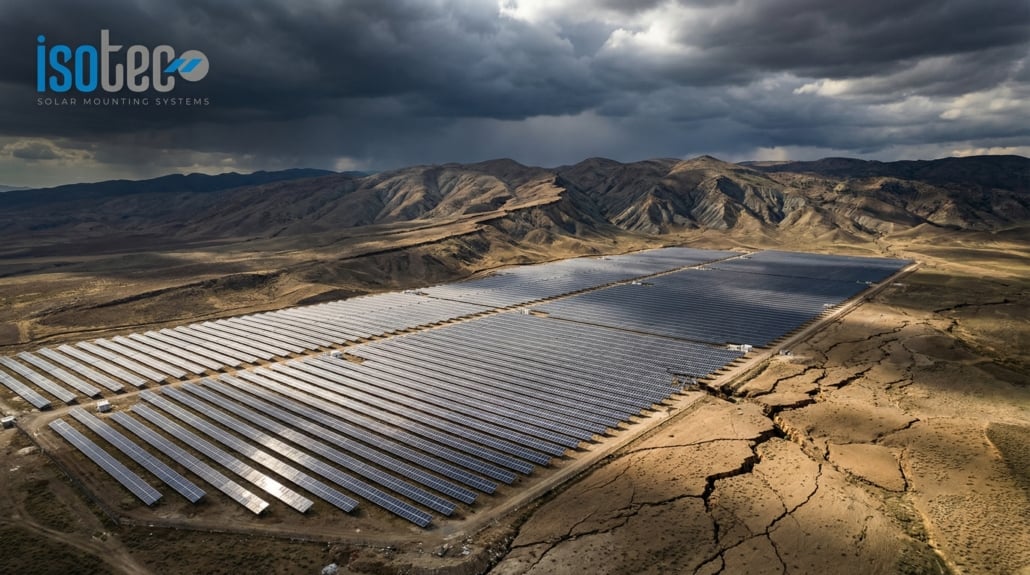
Türkiye topraklarının %96’sı deprem bölgesinde yer alıyor. Peki, bu coğrafyada kurulan güneş enerjisi santrallerinin montaj sistemleri gerçekten depreme dayanıklı mı? Doğru tasarlanmamış bir GES, sadece enerji kaybı değil — ciddi bir güvenlik riski demek.
Türkiye's Earthquake Reality and Solar Power Plant Investments
Turkey is located on the Alpine-Himalayan seismic belt, one of the most seismically active regions in the world. Devastating events from the 1999 Marmara earthquake to the 2023 Kahramanmaraş earthquake have repeatedly reminded us of the critical importance of structural resilience.
On the other hand, Turkey is one of the countries with the highest solar energy potential, with an average of 2,640 hours of sunshine per year. The rapidly increasing investments in solar power plants in recent years have highlighted the importance of installation system quality, especially in ground-mounted plants. The installation system of a solar power plant built in an earthquake zone must be designed to withstand seismic forces as well as wind and snow loads.
The critical question here is: Is your mounting system designed only for sunny days, or does it have the engineering infrastructure to withstand an earthquake as well?
Earthquake Regulations and Solar Power Plant Standards
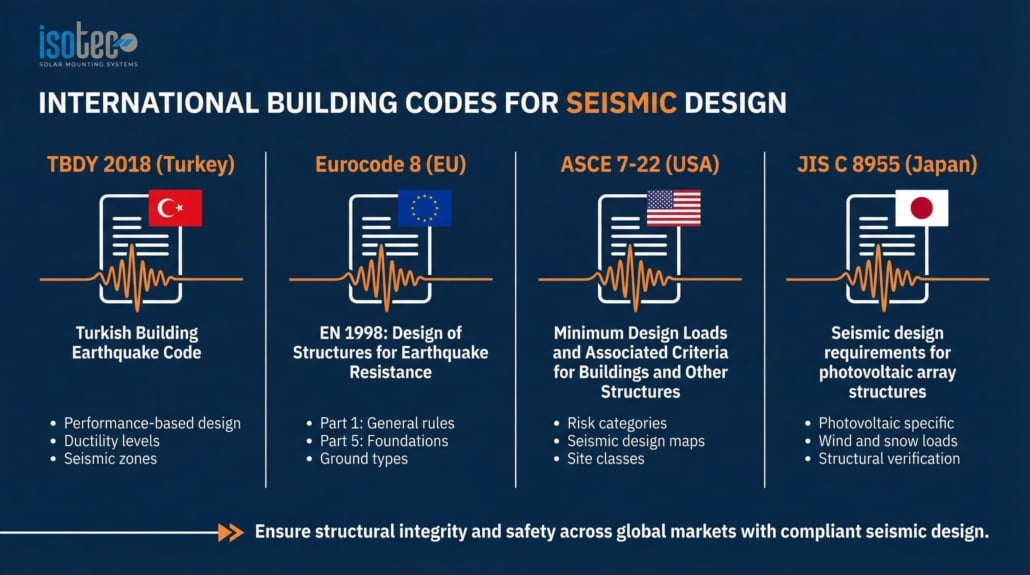
Designing solar power system installations in earthquake zones requires compliance with multiple national and international standards. In Türkiye, the primary reference sources are as follows:
- TBDY 2018 (Turkish Building Earthquake Regulations): It determines the basic framework for seismic load calculations in structural design. Solar power system mounting systems should also be considered as "non-structural elements" within the scope of this regulation.
- IEC 62817: It defines the design and testing requirements for solar panel mounting systems against mechanical loads.
- Eurocode 8 (EN 1998): It serves as a reference for earthquake-resistant building design for manufacturers exporting to the European market.
- ASCE 7: It is an internationally accepted standard for calculating wind, earthquake, and other environmental loads.
The common message of these standards is clear: A solar power plant in an earthquake zone needs more than just static load calculations. dynamic load analysis This requires considering seismic acceleration coefficients, soil class, and the natural vibration period of the structure.
Especially for power plants located in high acceleration zones (PGA > 0.4g) according to Türkiye's earthquake hazard map, it has become a critical requirement for the mounting system manufacturer to be able to provide seismic load calculations.
Foundation Types and Soil Mechanics
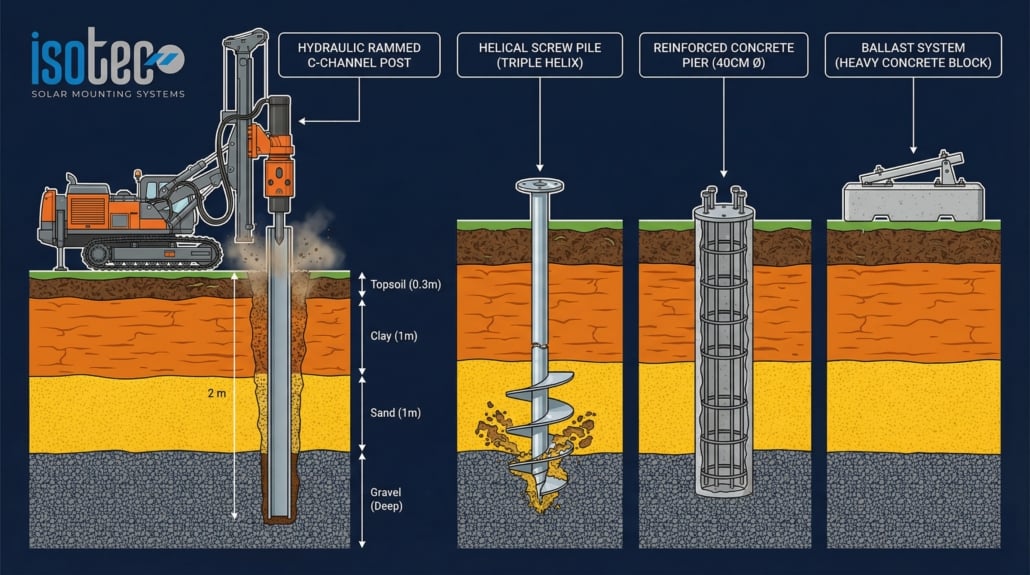
In ground-mounted solar power plants, the performance of the mounting system largely depends on the correct selection of the foundation type. This selection becomes even more important in earthquake zones because soil-structure interaction directly affects seismic behavior.
Three main types stand out:
Driven Pile
C-profile or sigma-profile steel piles are driven into the ground using a self-driving barrier type pile driver. This is the most common and economical method. In earthquake zones, its advantage is its adhesion to the ground through friction resistance and its elastic deformation capacity. However, its applicability is limited in rocky or very loose soils.
Helical (Screw) Pile
It is constructed by screwing steel piles with helical fins at their ends into the ground. It offers higher tensile strength compared to driven piles. It demonstrates superior performance against uplift forces that may occur during earthquakes. It is particularly preferred in soft clay and silty soils.
Reinforced Concrete Foundation
These are reinforced concrete structures built using point or strip foundations. They are used in rocky soils or in situations where driving/screwing is not possible. They have high seismic performance, but their cost and construction time are higher compared to other methods.
Soil testing is indispensable in selecting the foundation type. SPT (Standard Penetration Test) and soil classification Determining the foundation type without doing so poses an unacceptable risk in an earthquake zone.
Pull-Out Tests
Regardless of its basic type, it is absolutely essential in the field. pull-out test This test should be performed. This test verifies the pile's ability to anchor itself to the ground under real field conditions.
The modern pull-out testing process includes the following steps:
- Driving stakes or screws into designated test points
- Attaching the digitally controlled hydraulic tensile testing device to the pile.
- Installation of wireless digital displacement sensors.
- Gradual load application and simultaneous force-displacement data recording.
- Real-time field assessment via live graphics on a laptop.
Test results are compared with the safety factors of the design loads. This is generally the case in earthquake zones. minimum 1.5x safety factor This is the aim. So, if the design load is 10 kN, the pile is expected to withstand a tensile force of at least 15 kN.
Starting on-site installation without conducting pull-out tests is a serious engineering deficiency, especially in earthquake-prone regions. At ISOTEC, we emphasize the necessity of on-site testing in every project.
Assembly Details and Fasteners
An earthquake-resistant solar power system is not just about having a solid foundation. The connecting elements in the superstructure must also be designed with equal care. The points that will be most stressed during an earthquake are the pile-rail connection and the panel clamps.
Critical connection points and requirements:
- Pile-rail connection: Self-locking nuts should be used in bolted connections to prevent loosening due to vibration.
- Panel clamps: The dimensions of the mid-clamp and end-clamp must match the panel frame profile. Incorrect clamp selection can lead to panel displacement during an earthquake.
- Torque control: All bolted connections must be tightened with a calibrated torque wrench, and the torque values must be recorded.
- Relaxation control: Torque markings (paint markings) should be applied to the connection points to facilitate monitoring for loosening after assembly.
- Material compatibility: Appropriate insulation elements should be used between different metals to protect against the risk of galvanic corrosion.
The dynamic and cyclic nature of seismic loads does not mean that a connection resistant to static loads will also withstand an earthquake. Therefore, the connection details of the mounting system manufacturer must be carefully considered. fatigue resistance and cyclical load capacity They need to be able to provide their information.
ISOTEC Approach and Field Experience
ISOTEC has been manufacturing solar energy mounting systems for over 13 years. As a manufacturer exporting to 48 countries and supplying systems to more than 1,000 projects, the experience we have gained in projects in earthquake zones forms the basis of our design philosophy.
ISOTEC's approach to earthquake zones is based on the following principles:
- Internal static calculation: All static analyses of the assembly system are performed by the ISOTEC engineering team on a project-by-project basis. There is no external dependency.
- Seismic load integration: In earthquake-prone projects, seismic load calculations are included in the static report in accordance with TBDY 2018 and relevant international standards.
- Field testing support: A pull-out test protocol is provided for every project, and on-site technical support is offered when needed.
- 40+ system variants: The ISOGROUND field series offers solutions suitable for different soil conditions and earthquake zones.
- Quality assurance: Production quality is guaranteed with ISO 9001, CE and TSE certifications.
Our difference isn't revealed in sunny weather — it becomes apparent in storms, snow, and earthquakes. This isn't just a slogan; it summarizes our engineering approach.
Conclusion and Recommendations
When investing in solar power plants in earthquake zones, the choice of mounting system is a decisive factor in the success and safety of the project. In summary, the points to consider are:
- Inquire about the mounting system manufacturer's capacity to perform seismic load calculations.
- Do not decide on the foundation type without a soil survey.
- Insist on conducting a pull-out test in the field.
- Check the dynamic load capacity of the fasteners.
- Ensure the assembly team follows torque control and quality assurance procedures.
- Choose a manufacturer that offers engineering support instead of a cheap system.
Solar energy investments are designed to serve for decades. The probability of an earthquake occurring during this time is quite high in Türkiye's geography. Choosing the right mounting system protects your investment and ensures its safety.
Contact ISOTEC for safe solar power plant installation in earthquake zones.
ISOTEC Solar Mounting Systems is here to support you with safe and long-lasting solar power projects in earthquake zones. Contact us for technical support regarding your project's seismic analysis, foundation type selection, and mounting details.