
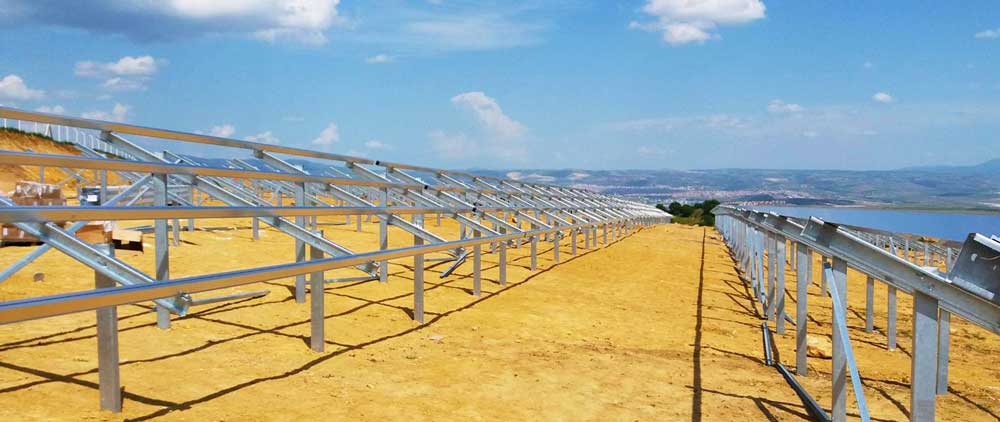
Solar energy mounting structures are steel elements installed beneath the solar panels and fixed to the ground by pile driving or concreting.
The selection of solar energy mounting structures is designed according to the region where the solar energy system will be installed, and is prepared by our in-house civil engineers based on the earthquake, snow and wind loads of that region.
Before the calculations begin, Soil Surveys are carried out in the region where the Solar Power Plant will be installed, and the bearing capacity of the relevant ground is determined and reported by a Geology firm.
In critical soils (where the bearing capacity is observed to be insufficient), pile driving and pull-out tests are carried out; for a 20-decare site, steel profiles are driven into at least 15 different spots with pile-driving machines, attached to a scale and pulled. Driving times and the forces during pulling are measured.
At this stage, all the loads in the area where the power plant will be installed (earthquake load, snow load, wind load, the structure's own weight, the load of the solar panels) are combined to form different load combinations. Calculations are made according to the most unfavorable combination, and it is determined whether the bearing capacity of the solar mounting structure is sufficient. During the design phase, it is confirmed that the cross-sections are not at their limit, and the static calculations are finalized.
After all these studies, 2D drawings of the solar mounting structure are added to the relevant calculations, and approval is obtained from the university civil engineering departments.