HOW TO INSTALL A SOLAR PANEL STEP BY STEP?
1. PREPARATION AND PLANNING
Before starting the solar panel installation, some preliminary preparations need to be made. This stage, for the smooth progress of the entire installation process, is of critical importance.
- Site Selection: The best location for solar panels is one that receives direct sunlight . Roofs, large gardens or open areas are ideal installation sites.
- Surface Examination: Make sure that the installation surface is sturdy, level and has sufficient load-bearing capacity. If your roof has any damage , it should be repaired before installing the panels.
- Panel Orientation and Tilt: For the panels to operate efficiently, they must be positioned at the correct orientation and tilt . In Türkiye, panels facing south, deliver the best efficiency when installed this way. In addition, the panel tilt should be between 30-35 degrees .
2. PREPARATION OF NECESSARY MATERIALS
You must obtain the necessary materials for solar panel installation. Here are the essential materials:
- Solar Panels: The solar panels you choose should be matched to the amount of energy you need.
- Mounting System: Frames on which the panels will be placed, and mounting arms.
- Cables and Connectors: Cables suitable for connecting the panels to each other and for the connection to the inverter .
- Inverter: A device that converts the direct current obtained from solar panels (DC) into alternating current (AC).
- Battery (Optional): If you want to store energy, a battery system will also be needed.
3. MOUNTING FRAME AND INSTALLATION OF PANELS
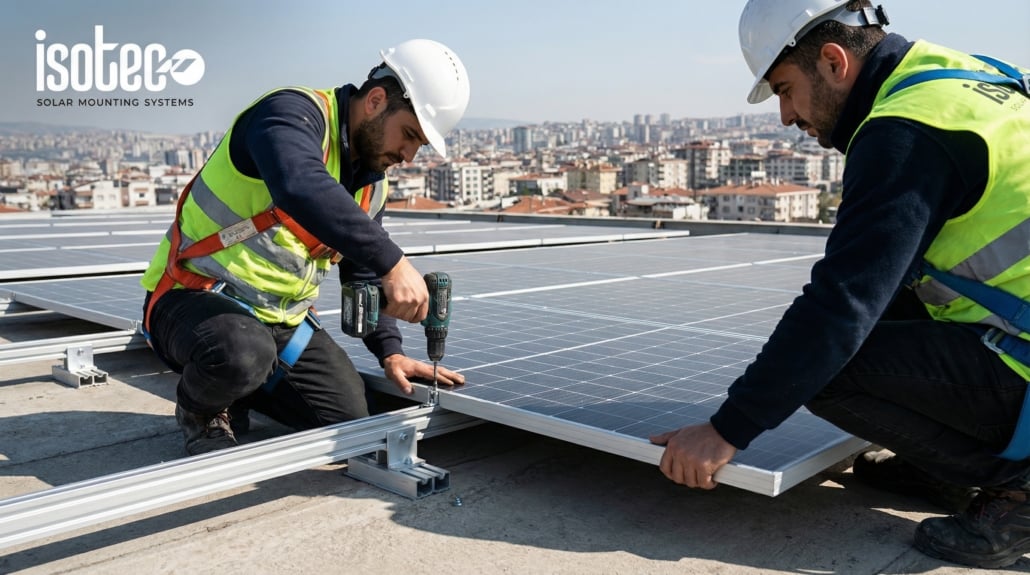
The first step of solar panel installation is to place the mounting frame firmly. The frame will hold the panels securely and ensure that they get the maximum yield from sunlight.
- Placing the Frame: The frames should be placed at the correct angle . Solar panels are usually installed on roofs using tilted mounting systems. This allows the panels to capture sunlight more efficiently.
- Fixing the Panels to the Frame: Once the panels are placed in the frames, they must be securely screwedand fixed in place. Care must be taken not to damage the panels during installation.
4. ELECTRICAL CONNECTIONS AND INVERTER INSTALLATION
To start generating electricity, solar panels must be connected to each other and routed to the inverter .
- Connecting the Cables: To make the connections between the panels, suitable cables must be used. It is important that the cables are placed correctly and the connections are made securely.
- Installing the Inverter: The inverter converts direct current (DC) into alternating current (AC) by converting, makes the electricity produced usable at your home or workplace . The inverter should be installed close to where the solar panels are connected.
5. BATTERY STORAGE SYSTEM (OPTIONAL)
If you want to store the energy produced by your solar energy system, a battery system will be needed. A battery stores excess energy so it can be used at night or when sunlight is low.
- Placing the Batteries: The batteries must be connected to the inverter and firmly secured.
- Charge Controller: Batteries must be charged correctly. For this purpose, a charge controller is used, this device manages the charge level of the batteries.
6. SYSTEM TESTING AND MONITORING
Once the solar panel installation is complete, it is important to test the entire system. In this step:
- Connection Check: Make sure the cables are connected properly and that the inverter is working correctly.
- Electricity Generation Test: Check if solar panels are producing electricity properly under sunlight.
- Monitoring System Setup: A tool to monitor your solar power system monitoring system . This allows you to track the efficiency of the system and helps detect potential faults early.
7. MAINTENANCE AND PERFORMANCE MONITORING
Once your solar system is installed, regular maintenance and monitoring is necessary. Solar panels generally have low maintenance requirements, but keeping the panel surface clean will increase the efficiency of the system.
- Panel Cleaning: Dust, dirt and leaves can block sunlight from reaching the panels. Therefore, panel cleaning should be done regularly.
- Inverter Check: The inverter should be monitored to check that the system is operating properly. If faults are detected early, they can be resolved before larger problems occur.
Solar panel installation, is a process that requires careful planning and the right steps to be followed. By following these steps, you can install an efficient and long-lasting solar energy system. Remember that correct installation ensures the efficient operation of the system and energy saving guarantees that it will work properly. If you do not have experience in the assembly process, working with a professional solar installation team is the best solution.